I. Core Principle
Ammonia nitrogen (as free ammonia or ammonium ions) reacts with Nessler’s reagent to form a pale reddish-brown complex. Absorbance is measured at 420 nm, with intensity proportional to ammonia nitrogen concentration. This method offers high sensitivity and specificity for trace ammonia nitrogen detection.
II. Scope and Key Parameters
|
Parameter
|
Value
|
Remarks
|
|
Applicable Water
|
Surface water, groundwater, domestic sewage, industrial wastewater
|
Covers environmental and polluted water monitoring
|
|
Detection Limit
|
0.025 mg/L (as N)
|
50 mL sample, 20 mm cuvette
|
|
Measuring Range
|
0.10–2.0 mg/L
|
Dilution required if exceeded; ensures linear accuracy
|
III. Interferents & Pretreatment Requirements
-
Key Interferents: Suspended solids, residual chlorine, Ca²⁺/Mg²⁺ ions, sulfides, organic matter, and color.
-
Pretreatment Protocols:
Residual Chlorine: Add sodium thiosulfate; verify removal with starch-potassium iodide paper.
Metal Ions: Mask with potassium sodium tartrate.
Turbidity/Color: Apply pre-distillation or flocculation-precipitation.
Note: Complex industrial wastewater requires distillation; otherwise, use HJ 536-2009 (salicylic acid method).
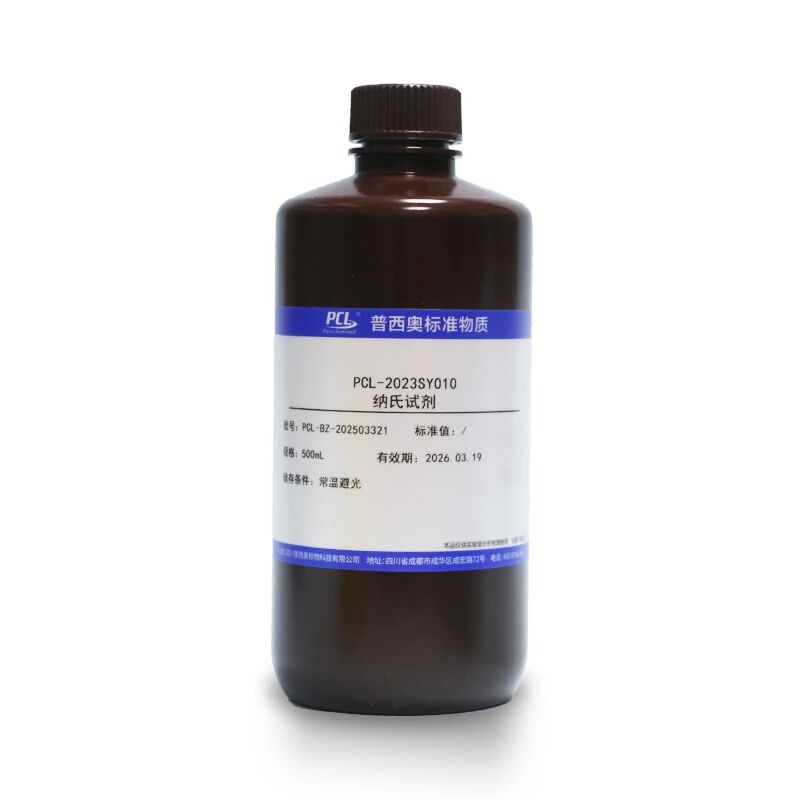
Technical Specifications: Nessler’s Reagent (Cas: 7681-11-0)
This product strictly complies with Section 4.4.1 (Mercuric Chloride-Potassium Iodide-Potassium Hydroxide Solution) of HJ 535-2009, ensuring authoritative and reliable results.
I. Product Attributes & Quality Control
|
Property
|
Specification
|
|
Composition
|
Mercuric chloride, potassium iodide, potassium hydroxide (dissolved in ultrapure water)
|
|
Preparation
|
Gravimetric-volumetric method; cleanroom (20±3°C); error ≤ ±1%
|
|
Appearance
|
Pale yellow transparent liquid; no precipitation or stratification
|
|
Traceability
|
Metrologically certified preparation process and apparatus; supports international recognition
|
II. Stability & Usage Guidelines
Shelf Life:
-
Unopened: >12 months; stability monitored continuously; anomalies reported promptly.
Packaging & Storage:
-
Packaging: Brown polyethylene bottle (light-blocking).
-
Storage: Ambient temperature, dark; equilibrate to (20±3°C) and mix before use.
-
After Opening: Seal tightly; use shortly to avoid contamination.
Note: Condensation due to shipping temperature variations does not affect performance.
III. Application Scenarios
Designed for HJ 535-2009 compliance, suitable for:
-
Routine surface/groundwater analysis (environmental monitoring stations).
-
Process control testing (wastewater treatment plants).
-
Industrial effluent compliance verification.
Conclusion
HJ 535-2009 is the benchmark method for ammonia nitrogen detection, reliant on standardized Nessler’s reagent. Our product minimizes experimental risks through strict preparation protocols, metrological traceability, and stability control. Directly applicable for samples with ≤2 mg/L ammonia nitrogen; highly interfered wastewater requires pretreatment for compliant results.

 中文
中文